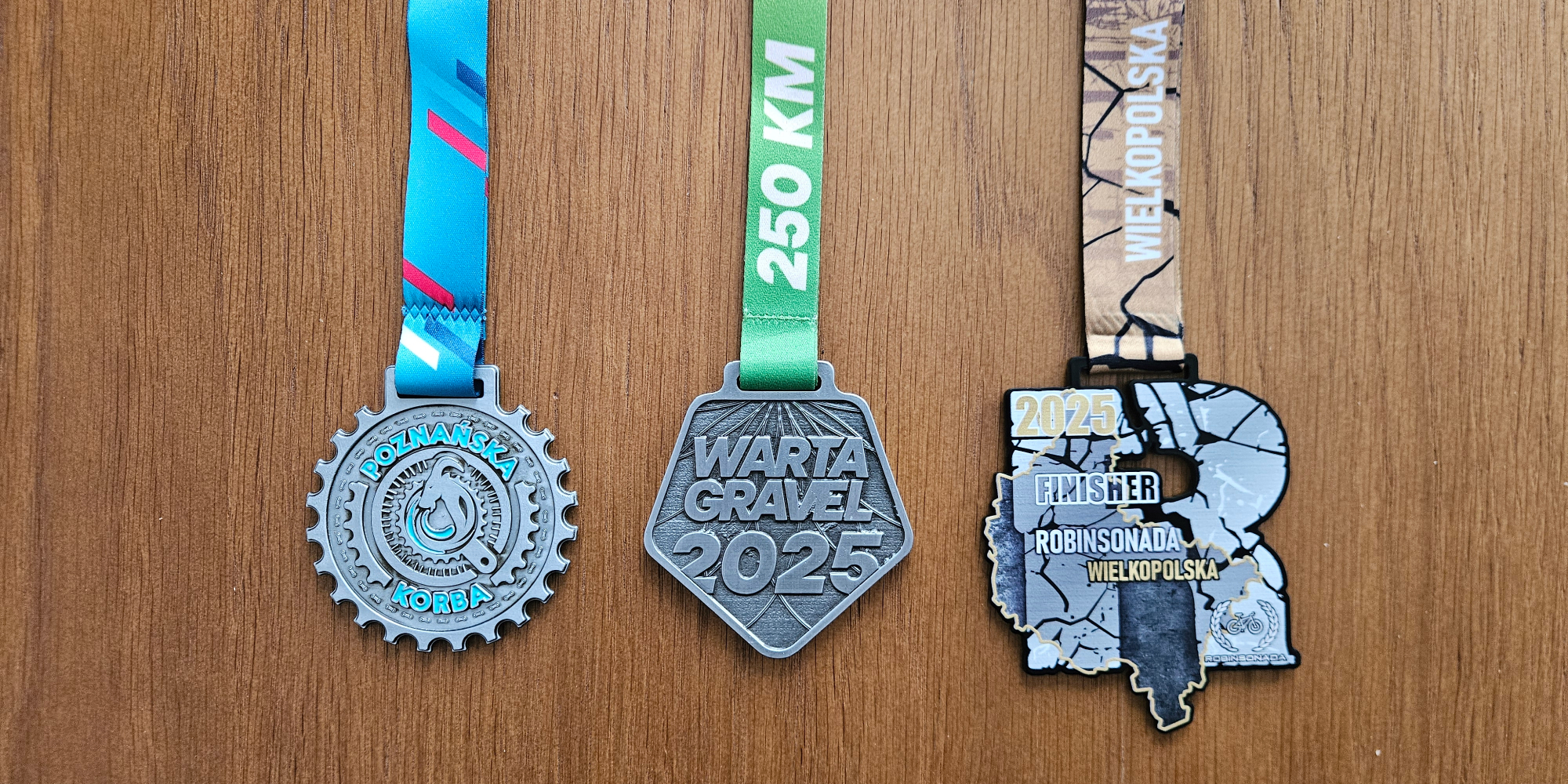
To make a post stand out, it should have a picture. So here are three small pieces of metal I want to show you. All you need to get one is to pay the entry fee for a marathon and keep pedalling until you reach the finish line. It sounds easy, and I know people for whom it’s easy, but not for me. For me, each medal is a story. Story of fear, of self-doubt, crises, but also of joy, new discovery, and internal triumph. Distance of each of those marathons was longer than the one before it, each one breaking my personal lifetime record, and each raising the bar for the next challenge.
The hardest was the last one, nearly 270km, most of it through demanding forest trails. By this time of year, daylight is short, and I knew that the toughest part of the route would come at night, on narrow singletracks, in places where wild boars and deer appear without warning. I even did meet deers, but though exhaustion was not surprised at all.
I still remember, a day before the start, sharing my fears with friends, and Dmitry, who known me more than twenty years, asked me: “Why not just skip this one? Or take the shorter distance?”. He has heard me saying many times: “There’s no life at the poles”. And it’s a matter of fact: the expeditions of Amundsen, Shackleton, and Scott proved it. So why risk? Why push beyond the comfort zone? It seemed illogical. But something had shifted in me. My only answer to him was: “The shorter distance has no sense for me.” And now, a few days after finishing the marathon, I think I can finally explain why, and how cycling has changed me.
I was never close to sports. Most of my time I spend in front of a computer. My first marathon happened almost by accident a few years ago. Friends invited me to join. I had always loved cycling, so I thought it could be interesting. I remember it vividly, when I came at the start line, I realized how not appropriate to this event I was. Everyone else had road bikes, cycling kits, clip-in shoes. I was in running shorts, sneakers, and riding a mountain bike. I had no training. My “nutrition plan” was a couple of nut bars. The distances were named Mini (70 km), Mega (120 km), and Giga (180 km). Since “Mini” didn’t sound cool enough, I went for 120 km, ignoring the 2,000 meters of elevation gain. Too many mistakes at once.
The question, “What am I doing here?” came into my head almost immediately after the start. Or rather, my body was asking it, sending distress signals to my brain. Several times I felt completely drained, but then somehow recovered and kept going. Some serpentine climbs were impossible, I had to push the bike on foot. But I kept moving forward.
Two moments from that first marathon are burned into my memory. The first: when I arrived at a pit stop completely exhausted, and someone gave me to drink Coca-Cola. The sugar hit was like a rocket booster, suddenly I rode another 30km as if someone was pushing me from behind. That was when I realized how little I knew about my own body, and how much there was to discover.
The second: when I was utterly spent, barely able to turn the pedals, I reached a fork. One road led to the finish by the shorter route, the other added another 50km. Every cell in my body screamed “Finish now!”. But I turned onto the longer route. In that moment, I understood: willpower and the mind can be stronger than the body. These moments stay forever, giving strength when life gets hard.
This year, the desire to test myself returned, but this time with more systematic training, experimenting with the bike, equipment, sports nutrition, proper gear, clip-in shoes. Yet, no matter the preparation, every marathon exposed weaknesses: mistakes in planning, food strategy, or bike setup. Each race was harder than the last, with new crises and challenges. But each also gave me the chance to meet extraordinary people and share experiences that I’ll remember for a lifetime.
What surprised me most was the absence of competing between cyclists. Everyone would stop to help if you had a problem or to support or encourage you. At first, it felt counterintuitive, wasn’t this supposed to be a competition? But then I realized: the only competitor you really face is yourself. You are the limit to going further, faster, safer. And once you see that, the focus shifts: to your own body, the trail, the right pace, the right nutrition, the rhythm that keeps you moving forward.
The last marathon broke several of my personal records at once. It was the longest, the toughest, both physically and mentally. Several times, I felt hidden reserves of strength open up inside me, something I’d never experienced before. I reached the finish line completely drained, without energy or emotion, yet my body was flooded with such strong hormones that I barely slept that night. In my mind, I kept replaying the route, kilometer by kilometer, analyzing mistakes, celebrating small victories, savoring the sight of the forests and the quiet hum of tires over firm sandy trails. Again and again, I kept realizing: this was something worth living through.
And coming back to my beliefs, yes, I thought that life doesn’t exist “at the pole”. But now I see that was a mistake. Because discovering those extremes is, though dangerous, an incredible adventure, and a story worth telling. We still remember Amundsen and Shackleton as true heroes. Their journeys continue to inspire us, to give us courage to push beyond our limits.
We learn to stay curious about the world, to take risks and, if we’re lucky, to win. First of all, to win against ourselves.